
Ait Ben Haddou Tours
A fortified village of earth-built houses on the old caravan road over the High Atlas, listed by UNESCO and used as a film location.
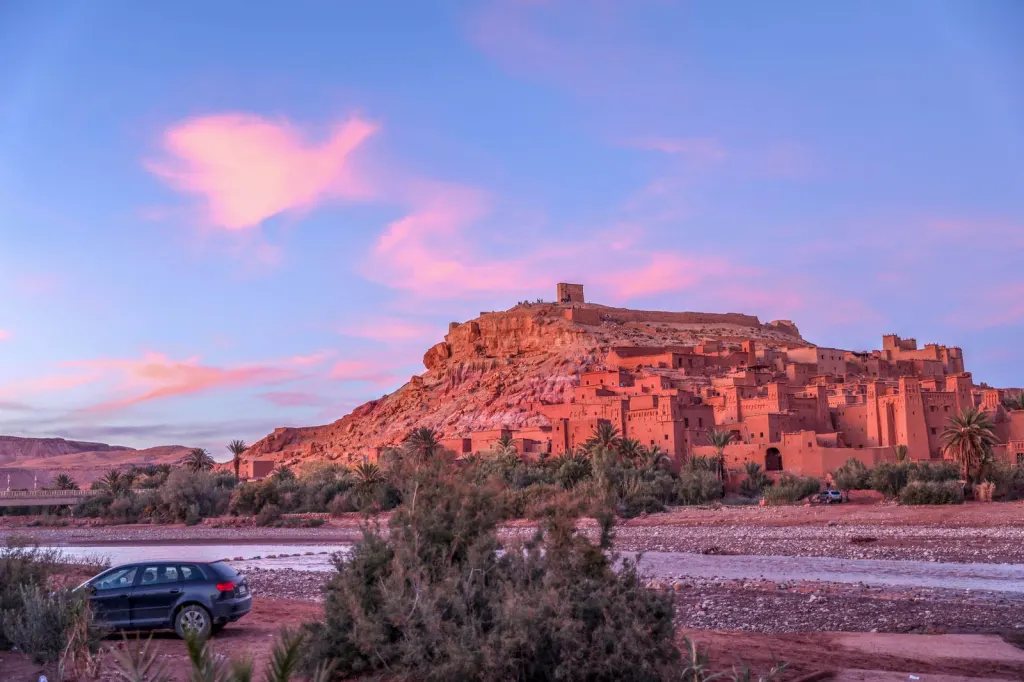
Ait Ben Haddou tours stop at a ksar: a fortified village of earth-built houses behind defensive walls, on the old caravan road over the High Atlas. UNESCO lists it as a World Heritage Site, and a few families still live inside the walls.
What a ksar is
A ksar is a group of houses, storage rooms and towers built together behind shared walls for protection. At Ait Ben Haddou the builders used rammed earth, sun-dried clay brick and wood. The lower floors of the taller buildings are rammed earth and the upper floors lighter clay brick, which keeps the weight off the walls. Earth is a practical material, but it needs constant maintenance, so the ksar has been restored in modern times, helped by its film work and its listing.
A World Heritage Site
UNESCO inscribed the ksar in 1987 as an example of the earthen architecture of southern Morocco, under two cultural criteria. The inscription text explains why it is protected, and a local committee looks after the site.
On the caravan road
For centuries this was a stop on the route that carried goods between the Sahara and Marrakech. The road crosses the High Atlas by the Tizi n’Tichka pass, one of the few crossings between Marrakech and the Draa Valley, and Ait Ben Haddou sits on the slope beside the Ounila River on the south side. Most of the village’s residents now live in a modern settlement across the river, linked to the ksar by a pedestrian bridge opened in 2011.
On foot
You climb through narrow alleys to the top of the hill, where the remains of a fortified granary look down over the village and the valley. The whole village and the river are laid out below. Wear shoes with grip, because the steps are uneven, and bring water and a hat in the middle of the day.
A film location
Many productions have used the ksar and the country around it. Lawrence of Arabia, The Mummy, Gladiator and Kingdom of Heaven are among the films listed, and Game of Thrones used it for television.
Where it falls on a route
Most travellers see it on the way from Marrakech to the desert, or on the way back, and it pairs naturally with Ouarzazate, a short drive away. To sleep nearby or fit it into another route, see Customized Trips.
On our tours
The 3 day Erg Chigaga desert tour stops here on the way south, as do the 3 day, 4 day and 5 day Marrakech to Fes desert tours, the 6 day Erg Chigaga tour and the 11 day Grand Morocco tour. The 4 and 5 day Marrakech to Fes tours visit the Telouet kasbah on the way here.
Tours
Ait Ben Haddou Tours: itineraries that stop here
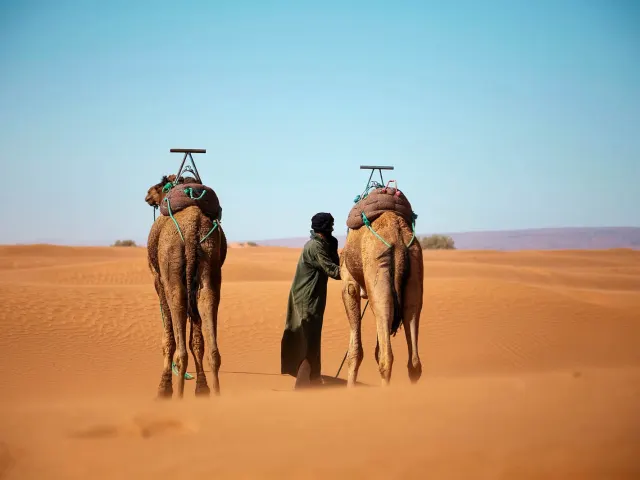
2 Day Zagora Desert Tour from Marrakech
The shortest Sahara trip we offer: two days from Marrakech, a sunset camel ride and one night in a private tent at our own camp near…